Incline Sleep is a specialty sleep education and solutions company dedicated to helping people understand and explore the practice of sleeping on a gentle, full-body incline.
Incline Sleep represents a different kind of TMU Trusted Member. Rather than offering a broad catalog of mattresses, the company is focused on increasing awareness of a specialized sleep practice with ancient roots and providing consumers with the information, practical guidance, and tools needed to explore its potential benefits responsibly.
Founders Larry and Jeff Wolfe, together with Jon Sampson and the broader Incline Sleep team, bring decades of experience in mattresses, foundations, adjustable bases, sleep-system components, and product sourcing. Jon also contributes more than 35 years of industry knowledge and firsthand experience with inclined sleeping, adding a practical perspective to the team’s focus on sleep optimization. Collectively, they came to recognize that sleeping position can be just as important as the mattress itself.
Unlike a traditional adjustable-bed position that primarily elevates the upper body and bends the sleep surface around the waist, full-body inclined sleep places the entire mattress on a gradual slope from the head toward the feet. This allows sleepers to remain supported by their mattress while resting at a gentle angle rather than lying completely flat. Some sleepers find this gentle elevation more comfortable, particularly when lying completely flat tends to worsen certain nighttime concerns.
Incline Sleep’s broader mission is educational. The company is developing InclineSleep.com as a comprehensive knowledge hub where consumers can learn about the history and principles of inclined sleeping, review available research, explore different setup methods, and better understand whether this approach may be appropriate for their individual circumstances.
For those looking for a simple way to experience inclined sleep without replacing their current mattress or purchasing a mechanical adjustable base, Incline Sleep offers its foam incline mattress wedge. Positioned beneath the mattress, the wedge creates a stable, gradual incline while preserving the comfort and support of the mattress already in use.
Incline Foam Mattress Wedge
(4″ & 6″) The Incline Foam Mattress Wedge provides a simple, non-mechanical way to experience full-body inclined sleep without replacing an existing mattress or purchasing a powered adjustable base.
Placed beneath the mattress, the supportive foam wedge creates a gentle, consistent elevation from the head toward the lower body. Because the sleeper continues to rest directly on the mattress, the mattress remains responsible for providing the primary comfort, pressure relief, and support.
Elevation Options
4-inch elevation: Provides a gentler incline for those who prefer a more gradual change in sleeping position.
6-inch elevation: Provides a more pronounced incline for those seeking greater elevation.
Both measurements refer to the height of the wedge at the head of the bed.
Sizes and Dimensions: Wedges are available in widths corresponding to all standard mattress sizes, including Twin, Twin XL, Full, Queen, King, and California King. All sizes extend 60 inches from the head of the bed toward the foot, creating a gradual taper beneath the mattress.
Key Features
Creates a gradual, full-width incline
Designed for use beneath an existing mattress
Made with durable, high-density CertiPUR-US® certified foam
Available in 4-inch and 6-inch elevation options
Contains no motors, moving components, or electrical parts
Available for all standard mattress sizes
Full wedge purchase price credited toward a future Incline Foundation upgrade
Setup and Compatibility
The wedge is positioned beneath the mattress, with the elevated end placed at the head of the bed. It should rest on a stable foundation or platform capable of properly supporting both the wedge and the mattress.
It may be a practical option for consumers who:
Want to continue using their existing mattress
Prefer a fixed, full-body incline
Do not need or want a powered adjustable base
Want a solution without motors, controls, hinges, or mechanical components
Compatibility can depend on the mattress’s construction, thickness, flexibility, weight, and condition. Consumers using split mattresses, nonstandard dimensions, or unusually rigid or heavy mattresses should confirm compatibility before purchasing.
Highlights: Inclined Sleep Specialist | Manufacturer-Direct | Fits Existing Mattresses | Incline Foundation Upgrade Credit | Free Shipping USA
Why Sleep on an Incline?
Full-body inclined sleep places the sleep surface on a gentle slope, with the head positioned higher than the feet. Unlike arrangements that elevate only the head and upper torso, this approach maintains a gradual incline beneath the full length of the mattress and avoids creating a pronounced bend around the waist.
People explore inclined sleep for greater comfort or because certain nighttime concerns become more noticeable when lying completely flat. Individual experiences vary and may depend on a person’s health, sleeping position, mattress, degree of elevation, and other circumstances.
Potential Benefits of Inclined Sleep
Support for nighttime reflux: Sleeping with the head and upper body elevated may help reduce nighttime acid reflux symptoms for some sleepers by making it more difficult for stomach contents to move upward while lying down.
More comfortable breathing for some sleepers: Some people find that an elevated sleeping position allows them to breathe more comfortably or helps reduce snoring. Inclined sleep should not be considered a substitute for professional evaluation or prescribed treatment for sleep apnea or another respiratory condition.
Greater comfort when lying completely flat is difficult: A gentle incline may provide a more comfortable resting position for people who find sleeping on a completely level surface uncomfortable.
A gradual, full-body sleep position: Because the mattress is gradually inclined rather than sharply bent, sleepers can remain supported by the familiar comfort and support system of their mattress.
Practical Advantages
Continue using an existing suitable mattress
Avoid the need for a powered adjustable base
Creates a consistent incline across the full mattress
Explore inclined sleeping with a simple, non-mechanical setup
Results vary, and inclined sleep is not a substitute for medical diagnosis or treatment. Individuals with diagnosed sleep or respiratory conditions, significant health concerns, or mobility limitations should consult an appropriate healthcare professional before substantially changing their sleeping position.
Incline Sleep vs. Traditional Zero Gravity Positioning
Traditional adjustable bases and full-body inclined sleep both change the sleeper’s relationship to a flat horizontal surface, but they do so in very different ways.
A typical zero-gravity position raises the upper body while also elevating the knees, creating an articulated or somewhat “V-shaped” sleep surface. This position is primarily associated with back sleeping and can be comfortable for relaxation, reading, television viewing, elevating the legs, or for sleepers who prefer a semi-reclined position.
Zero-gravity positioning has also been widely promoted in the adjustable-bed market in connection with concerns such as snoring, reflux, circulation, pressure relief, and general sleep comfort. However, the geometry of an articulated base is not the same as sleeping on one continuous plane.
For side sleepers and combination sleepers, that distinction can matter. A pronounced bend through the middle of the mattress may make it more difficult to maintain a familiar lateral sleeping posture. Instead of the shoulders, torso, hips, and legs resting along one continuous surface, different parts of the body may be positioned at different angles.
Depending on the sleeper, mattress, and amount of articulation, that may feel awkward or may make it harder to maintain the alignment and comfort the sleeper normally seeks during side sleeping.
Full-Body Incline: A Different Approach
A full-body incline approaches elevation differently.
Instead of bending the mattress at the waist and knees, the entire sleep surface remains on one continuous plane while gently tilting from head to foot. The objective is not simply to raise the head. It is to allow the sleeper to maintain a more familiar sleeping posture while changing the angle of the entire sleep surface. This can allow:
Side sleepers to remain in a more familiar side-sleeping position without a pronounced bend through the middle of the bed.
Back sleepers to remain supported along one continuous inclined surface.
Combination sleepers to change positions more naturally during the night.
The mattress to continue performing its normal pressure-relief and support functions.
Head-to-foot incline without requiring the torso and legs to rest at several different angles.
For people who spend much of the night on their side, this difference between articulation and whole-body incline may be particularly important.
Benefits of Sleeping Inclined – Full Body Tilt
A full-body incline takes a different approach. Instead of bending the mattress at the waist and knees, the entire sleep surface stays essentially flat while gently tilting from head to foot. For the 75% of people who spend much of the night on their side, this distinction is particularly important. The objective is not simply to elevate the head, but to do so without substantially changing the basic geometry of a natural sleeping surface.
Sleeping Inclined allows:
Side sleepers can maintain a geometry naturally suited for their side-sleeping posture.
Back sleepers can remain on a continuous inclined plane sleep surface.
The mattress to continue providing its normal pressure relief and support.
The sleeper to experience foot-to-head elevation without requiring a pronounced bend through the torso.
Is One Approach Better?
Neither approach is universally right for every sleeper. As with mattress comfort and support, individual response matters. Body type, sleep position, mattress construction, degree of incline, mobility, and health considerations can all influence the experience.
Traditional “zero gravity” adjustable bases offer considerable flexibility as a lifestyle and comfort feature. They can be useful for sitting up, reading, watching television, elevating the legs, or finding a comfortable back-sleeping position.
For people who want to sleep through the night in a familiar, natural sleeping posture, however, maintaining one continuous sleeping plane may offer advantages, which are important especially for side sleepers and combination sleepers.
Full-body inclined sleeping preserves that continuous surface. Rather than folding the mattress through the waist and knees, the entire bed is gently tilted from head to foot. The sleeper can therefore remain in a familiar sleeping position while the mattress continues to provide the support and pressure relief for which it was designed.
What About Side Sleepers?
This is where the distinction becomes especially relevant.
Traditional zero-gravity positioning is generally designed around the geometry of a reclining back sleeper. A side sleeper may be able to use a modestly articulated position comfortably, but increasing the bend at the waist and knees can make the position progressively less compatible with conventional side sleeping.
Full-body incline does not require that bend. For a side sleeper, the shoulders, torso, pelvis, and legs can remain along the same continuous sleep surface while the entire bed is inclined. This does not mean that every side sleeper will prefer an incline, nor that every adjustable-base position is unsuitable for sleeping. It does mean that whole-body incline and articulated elevation are mechanically different approaches, and that difference deserves to be understood when choosing between them.
Why Isn’t Full-Body Inclined Sleeping More Familiar?
One of the challenges is simply awareness: Many consumers are familiar with adjustable bases but have never been introduced to full-body incline as a separate sleep-positioning concept. They may assume that raising the upper section of an adjustable bed is the only practical way to sleep with the head higher than the feet.
Cost and product availability have also played a role: Historically, full-body tilt has often been associated with specialized or higher-priced adjustable-base designs rather than with simple, accessible sleep solutions. That is beginning to change. A growing number of manufacturers have incorporated full-body tilt or similar head-to-foot incline functions into adjustable-base designs, while other products achieve the same basic geometry more simply.
Incline Sleep’s stated goal is to increase awareness of this distinction and make full-body inclined sleeping easier for consumers to understand, experiment with, and access. “Making the gravity work for you, not against you“
Four Practical Principles Behind Full-Body Inclined Sleep
Simple: Rather than bending the sleeper into several different angles, the entire sleep surface is gently inclined while remaining on one continuous plane.
Accessible: Full-body incline does not necessarily require a premium adjustable base. Depending on the setup, it can be achieved through a range of products and price points.
Natural Sleeping Position: The sleeper can continue using familiar back, side, or combination sleeping positions without requiring a pronounced bend through the waist and knees.
Evidence and Experience: Interest in inclined sleeping comes from both published research into specific forms of head-of-bed elevation and from longstanding consumer experience. Typically, users report significantly better breathing, deeper and uninterrupted sleep, more daytime energy, and overall improved health. This said, the quality and applicability of the evidence varies by condition and method of elevation, so individual health claims should be considered carefully and in the appropriate medical context.
Historical Roots and a Modern Revival
Although full-body inclined sleeping may seem new to many consumers, sleeping on a sloped surface has a much longer history.
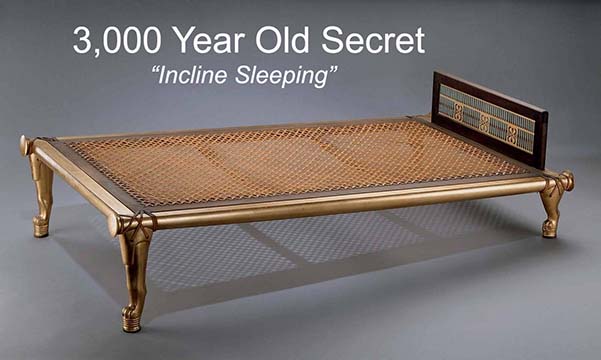
We know, for example, that ancient Egyptian beds were often built higher at the head than at the foot, creating a sloping sleeping surface. A footboard helped prevent the sleeper from sliding downward. This practice existed thousands of years ago, although we should not assume that the Egyptians used inclined beds for the same reasons being explored today. Metropolitan Museum of Art Resources
In more recent history, one of the most persistent advocates of inclined sleeping was Andrew K. Fletcher, who spent decades experimenting with and promoting what became known as Inclined Bed Therapy. Fletcher believed that gravity and sleeping angle deserved much more attention and encouraged people to investigate what happens when the entire bed is gently raised from foot to head. His work kept the idea in circulation at a time when it remained largely outside the mainstream mattress and sleep industries.
Today, Larry Wolfe and his son Jeff Wolfe, co-founders of Incline Sleep, are continuing that exploration from within the mattress industry. Larry brings five decades of mattress-manufacturing experience and became interested in a fairly simple question:
⚠ If people can sleep with the entire body on one continuous surface, why should elevation necessarily require bending the mattress … and the sleeper… at the waist and knees?
Larry brings five decades of mattress-industry experience to the project. His interest in inclined sleeping developed from the intersection of mattress design, sleep positioning, and the question of whether consumers could benefit from a simpler way to maintain a continuous sleeping surface while introducing a gentle head-to-foot incline.
That question became part of the reason behind Incline Sleep. Larry and Jeff’s larger goal is to help people understand the difference between an articulated sleeping position and a gentle full-body incline, make the concept more accessible, and encourage further discussion and research into where inclined sleeping may prove to be useful.
For TMU, that is also where the subject becomes interesting. There is history behind it, there are people reporting meaningful personal experiences, and there is research worth examining, but there is also plenty still to learn. Bringing those pieces together carefully gives consumers a much better basis for deciding whether inclined sleeping is something they would like to explore.
 Manufacturer - Inclined Sleep Foundations