Mattress quality hinges on two essential elements: comfort and support. A truly effective mattress balances these qualities. Together, they create the ideal sleep surface that feels comfortable while promoting healthy posture throughout the night.
Comfort
Comfort is mainly the ability of a mattress to form a cradle that is deep enough to spread your weight over the surface of your mattress to relieve pressure points. Nothing more than this… If you are lying down on an unforgiving floor, all of your weight is bearing down on just the few points of contact between a rounder you and the flat floor. Most of your weight would be on your hip and shoulder area on your side, on your rear end and upper back on your back, and on your pelvic or stomach area and chest on your stomach. Without any contouring, the points that are bearing your weight will likely get more than a little sore once you lie there for a while.
On the other hand, if you lie down on a piece of wood that was perfectly contoured to the shape of your body, it would feel very soft because your weight would be spread out over a much larger area. Now, granted, it wouldn’t feel very soft as soon as you moved and the shape of your body that was against the wood changed since the wood wouldn’t change along with you, but as long as you were perfectly still, it would relieve any pressure on the different parts of your body. Most of us have had the experience of going to a favorite place on a sunny day and finding the “perfect rock” to lie on in the sun. Sometimes we have fallen asleep for long enough to wake up with a sunburn. This is another example of how good weight distribution can be very comfortable no matter how hard or soft the material we are lying on. In other words, pressure relief and the feeling of comfort that is connected to it is dependent on a mattress’ ability to form a cradle around you that conforms to your shape, is deep enough to fill in the gaps, and is changeable enough to make a new cradle every time you move. This is the basis of pressure relief and requires sinking IN. The top few inches of a mattress, or what we call the comfort layers, is the part of a mattress that does most of this (if you have any doubts about this, just imagine putting a piece of plywood on the best conforming innerspring or foam in the world and guessing how you would feel).
The main reason for the different materials used in the comfort layers of a mattress is to spread out the pressure of your weight in many different sleeping positions. Each type of material does this a little differently, and some are better than others. We will explore all of these in the different sections.
Support
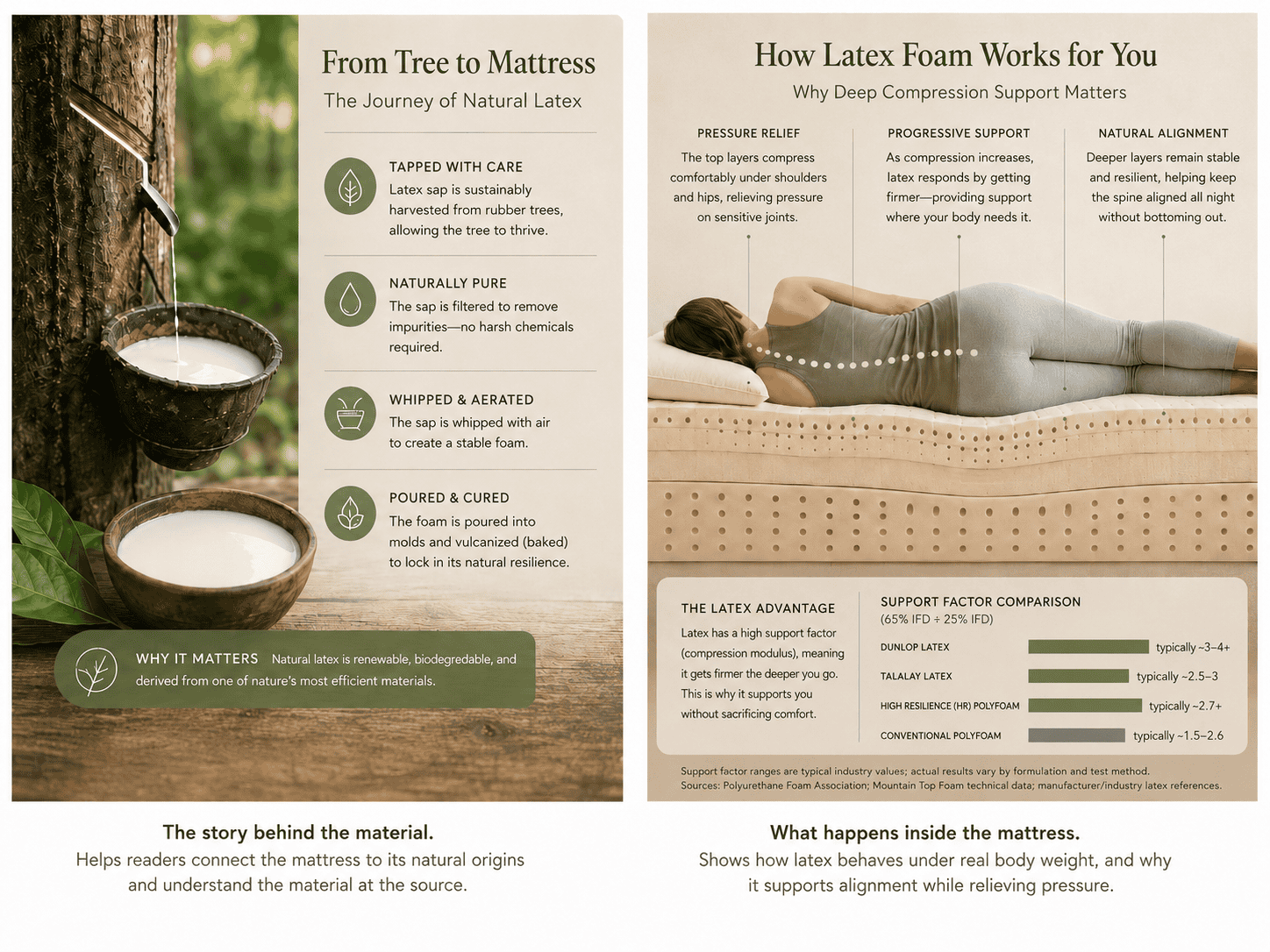
Support is the ability of a mattress to keep your spine aligned while you are sleeping. What exactly, though, does “spinal alignment” mean? In simple terms, it means that while you are sleeping, your spine needs to be in the same alignment as when you are standing up straight with good posture. When you look at someone’s spine from the front, you will see that the spine is very straight and doesn’t “bend” from side to side. This means that when someone sleeps on their side, their mattress needs to keep their spine very straight. On the other hand, if you look at someone’s spine from the side, you will see that it forms a natural “S” curve with the small of the back and the neck bending inwards and the upper back and the pelvis bending outwards. This means that someone who sleeps on their back or stomach needs a mattress that keeps their spine in this natural “S” shape while they are sleeping. This means that heavier parts of your body need to be “held up” or they will be too low, and other parts of your body need to be allowed to “sink-down,” or they will be too high. One material property that helps explain this is support factor (also called compression modulus), which describes how much more firmly a foam resists as it is compressed more deeply—helping heavier areas of the body receive progressively greater support without making the surface unnecessarily firm.
Different mattresses or combinations of firmer and softer materials are better or worse at doing this, especially when you consider that very few people sleep in the same position all night long and that their support needs change constantly through the night as they change position. Some materials and types of mattress constructions have a larger range of positions that they can keep you in alignment than others. A mattress that doesn’t allow parts of you to sink down far enough to have proper alignment and a mattress that allows parts of you to sink down too far for proper spinal alignment would both give you poor support. The myth that firmer mattresses offer better support is long gone as more people recognize that spinal alignment needs a mixture of softness and firmness and is interconnected with how well a mattress relieves pressure. The support core of a mattress is mainly responsible for support as it controls how far you sink DOWN beyond the point that you sink IN to your comfort layer and keeps your spine aligned.
There is a second part of support though, and that is holding up the more recessed (and generally lighter) parts of your body that don’t come into contact with the support core so they don’t “collapse” because there is only air underneath them. This second part of support is also a function of the upper cradle, as it allows you to “fill in” these gaps by using better materials in the comfort layers that can “push back” to differing degrees and hold them up. This is an important part of supporting the lumbar area of your body, as this is usually the biggest gap in your profile.
In your search for a mattress, never forget that these two things … comfort and support … are what you are looking for … together.
Softness, firmness, coil count, zoning, coil gauge, ILD, and all the thousands of other “words” you will hear while you are looking for a mattress will almost all boil down to these two things.
If someone tells you something or uses a buzz word that makes little sense to you, simply ask them either …
- Does this “word” somehow make the mattress contour to your body better in all your sleeping positions and adjust itself while you move? How exactly does it do that? … or …
- Does this “word” somehow make the mattress keep your spine in better alignment in all your sleeping positions and adjust itself while you move? How exactly does it do that?
A third question that is increasingly important these days of lower quality materials is “how long will it last before it stops doing what it does in your showroom?”
What you are looking for is a mattress that lets you sink IN enough to form a cradle, relieve pressure, and fill in and hold up your recessed parts, while at the same time controls how far each part of you sinks DOWN into the mattress to keep your spine aligned and “support” the cradle above it. If you are in any doubt about what you are being told (once again bearing in mind that after this article alone you may know more than many mattress salespeople), just come back here or to our forum to find out the truth behind the words.
The benefit of a basic mattress education
Most importantly, take your time and don’t worry about missing some great “sale”. They are mostly fake and meant only to get you to buy before you leave the store and do some comparisons. You will find out how they work as well and how you can save more than any sale by knowing where to go and who to buy from. Some basic education about mattresses and where to buy them will save you much more than any sale, both in terms of money and in terms of how well you sleep for the next few or many years.
So now that you know the 2 basic functions of a mattress … let us move on to the overviews for the different sections.
- The different types of mattress support cores … and their similarities and differences →
- The different types of mattress comfort layers … and their similarities and differences →
- The different ways that the layers of a mattress are put together and work together →
- How your preferences, sleeping style, and statistics can affect your personal choices →
- Using what you know in a simple five-step approach to choosing your perfect mattress →
We recommend that you read the overviews in order first and then go back and read the individual pages in each section if you need more detailed information as they have been designed to be more informative and “progressive” in that order. As in all things, however, feel free to scan them in any order you prefer.
Don’t forget that our forum is always there to help you at every step along the way.