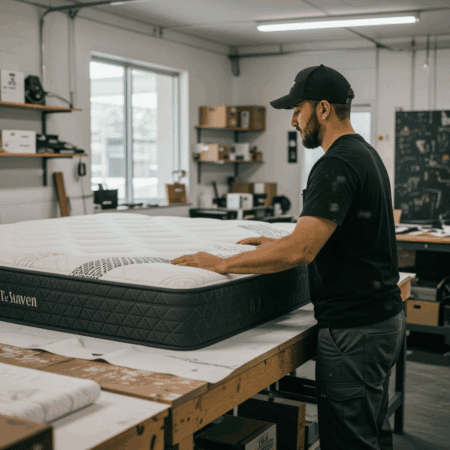
A mattress in its simplest form is a sleeping system with different parts which work together to do two main things. These are to provide you with comfort and provide you with support in all your different sleeping positions. That’s it … everything else is secondary to these.
For comfort, which is mainly about pressure relief, your mattress needs to conform to your body shape and form a cradle that is deep enough to spread your weight over the surface of the mattress and relieve pressure points. We call this sinking IN. This is the role of the top part of your mattress or what is called the comfort layers. This may include one or more thinner layers and includes any quilting which is on the very top of your mattress.
For support, which is mainly about spinal alignment, your mattress needs to control how far different parts of your body sink DOWN into a mattress. This is primarily the role of the lower parts of your mattress or what is called the support layers. There may be one or more support layers and together they are called the Core of your mattress.
Sometimes in certain types of mattress constructions, there can be a middle layer that helps with both pressure relief and spinal alignment. This is called a transition layer and contributes to both the comfort and support of your mattress.
Note that sinking in is not the same as sinking down. Sinking IN means how well a mattress forms a cradle to your body shape and is necessary for pressure relief. It is only possible with the upper layers. Sinking Down is all about how deeply different parts of your body sink into a mattress in total regardless of the cradle formed by the upper layers. It is affected by all the layers of a mattress and is primarily concerned with spinal alignment. Two examples will make this clear. If you lie in water it will form itself to your body shape. This is sinking in. If you lie in a hammock, there is no cradle and you may have pressure points even though parts of you are sinking lower than others. This is sinking down.
The middle layers of a mattress play a dual role and can help to differing degrees with both sinking-in (for pressure relief and comfort) and sinking-down (for spinal alignment and support) depending on the construction of the mattress. Thinner comfort layers often need the help of the layer below it to form a cradle that can relieve pressure. Thicker layers do not need as much help so the layers below can be firmer and primarily concerned with holding up the heavier parts of your body to ensure spinal alignment.
When a middle layer helps more with pressure relief, we call that a “progressive” mattress construction. When a middle layer is either not there at all or is not needed for pressure relief and contributes more to support, we call that a “differential” construction. More about these in another section.
It’s rather amazing that in all the hype and misinformation that exists in the industry that these two basic fundamentals have been all but forgotten and/or complicated beyond recognition. You will often hear about how comfortable an innerspring may be when in reality it is a support layer that only “helps” with comfort in certain cases. All innersprings are primarily concerned with the support qualities of your mattress. Comfortable innersprings is mostly just “sales talk”.
You will also often hear how supportive a comfort layer like memory foam is. This too is pure “sales talk” since the upper layers are primarily about pressure relief not support and in the case of memory foam it has little ability to support at all and is completely dependent for this on the non-memory foam layers below it. Remember that Upper comfort layers = pressure relief/comfort and lower support layers = spinal alignment/support and middle layers can help with both.
Mattress Materials and Comfort
In the following sections, you will read all about these two functions from different perspectives and how different types of people need different combinations of layers and materials that work together in different ways to give you enough of both to fit your own unique needs and body weight and profile.
In general terms … when you hear someone talk about “firmness” … they are (or should be) talking about the deeper layers of a mattress. When you hear someone talk about “softness” they are (or should be) talking about the upper layers of a mattress. Those who don’t understand the difference between the roles of the different mattress layers and who “confuse” the issue by talking about a mattress as if it is either all “soft” or all “firm” shouldn’t be selling mattresses. Even by the end of this first article, you will probably understand more than they do.
ALL mattresses are made up of different layers with different degrees of both softness and firmness in the different layers. The softness and firmness of foams is measured using a term called ILD (also called IFD). Lower numbers are softer and higher numbers are firmer. The range in more commonly understood terms is approximately as follows … bearing in mind that softness and firmness itself is very much based on individual perception.
Softness/Firmness | ILD/IFD |
|---|---|
XX Soft | Less than 14 |
X Soft | 14 – 17 |
Soft | 18 – 22 |
Medium-Soft | 23 – 27 |
Medium | 28 – 32 |
Medium-Firm | 33 – 37 |
Firm | 38 – 42 |
X Firm | 43 – 47 |
XX Firm | More than 47 |
Learn more about how each of these really are and how they relate to all the words, ideas, and advertising hype you will be exposed to as you begin your search.