What Twenty Years of Building Latex Mattresses Taught Us About Firmness Ratings
We get some version of this call a few times a week: someone has been researching latex mattresses for a month, they’ve got a spreadsheet going, and they want to know …
Why one company’s Medium is ILD 28, another’s is 32, and a third won’t publish numbers at all? .
Usually they’re hoping we’ll just tell them the right number.
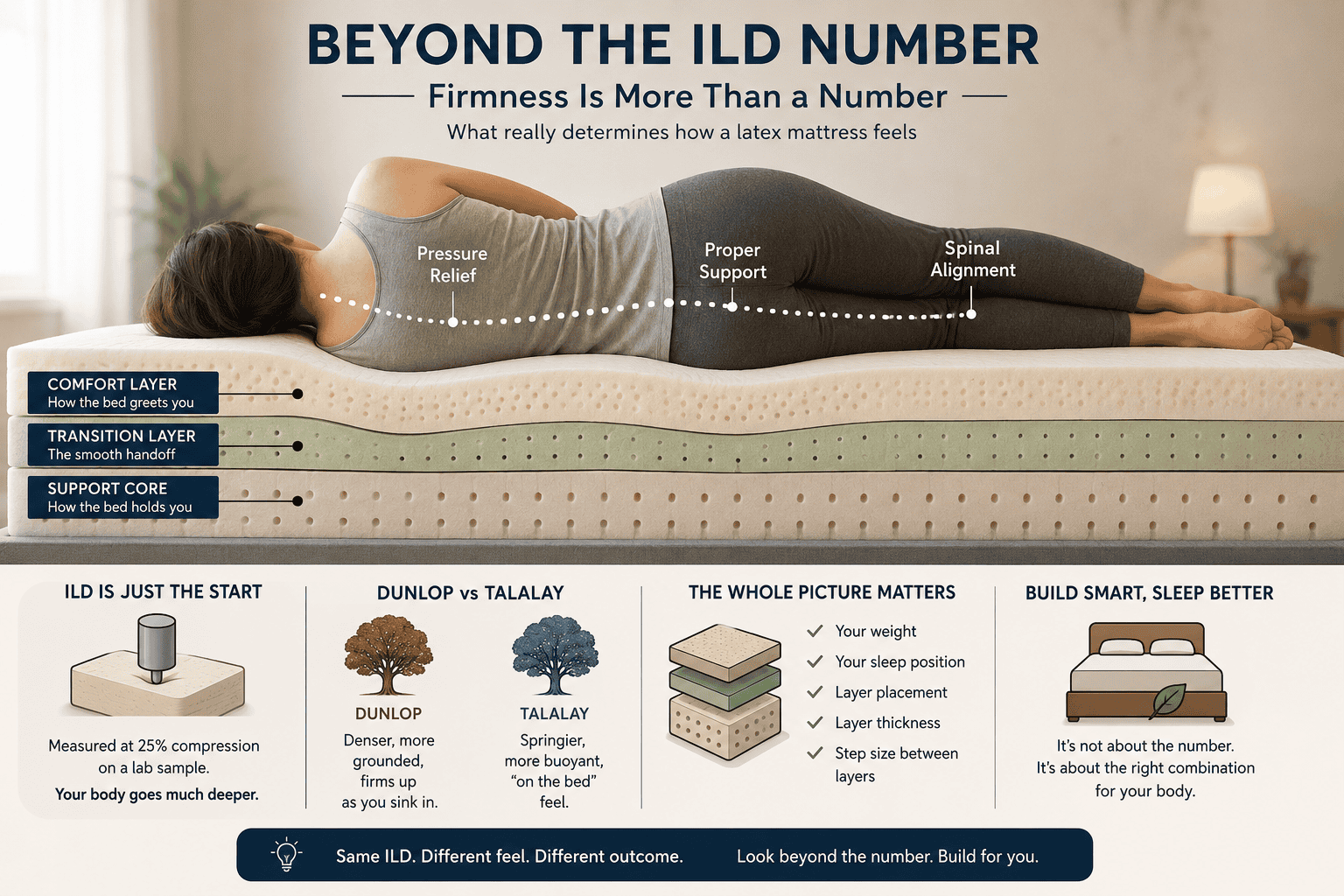
Here’s the uncomfortable truth we’ve learned from building layered latex beds since 2007: the number is real, it matters, and it will still mislead you if you don’t know what it’s actually measuring. Two mattresses with identical published ILDs can feel noticeably different. The same ILD behaves differently in Dunlop than in Talalay, and differently again depending on where that layer sits in the stack.
We’ve had two customers order nearly identical builds in the same month, one thrilled and one asking for a swap. Both outcomes made perfect sense once you looked past the spec sheet.
So this isn’t another “what is ILD” explainer. You can find that anywhere. This is what the number leaves out.
Quick recap for anyone new: ILD (Indentation Load Deflection) is measured by pressing a 50-square-inch metal plate into a latex sample and recording how many pounds of force it takes to compress it 25% of its height. ILD 32 means 32 pounds got the plate a quarter of the way in. Higher is firmer.
Simple enough. Now the parts that trip people up.
The test stops at 25% compression. Your hip doesn’t. Latex gets progressively harder to compress the deeper you go, and it does this more aggressively than polyurethane foams do. The industry term is compression modulus, sometimes called support factor: the ratio between the force at 65% compression and the force at 25%.
TMU’s own tutorials call this ratio the support factor, and the numbers there are worth knowing: Talalay runs around 3, Dunlop closer to 4, and most other foams sit well below either. In practice, it means two foams can match exactly at 25% and part ways completely by 50%, which is about what a side sleeper’s hip does to a soft comfort layer. This deep-compression push-back is why a soft latex layer still feels like it’s holding you up rather than swallowing you. It’s also the property that cheap foams imitate the worst, and the reason “feels like latex” claims tend to fall apart around 2 a.m.
The test is run on a thick reference core in a lab, not on your mattress. The 3-inch layer you actually buy, zipped inside a cotton and wool cover, stacked on two other layers, expresses that same material differently. When we quote a layer’s ILD, we’re telling you about the rubber, not making a promise about the finished mattress. Any manufacturer who tells you otherwise is simplifying.
And a plate is not a person. The plate spreads force evenly; you don’t. A side sleeper drives most of their weight through a shoulder and a hip. A back sleeper spreads it out.
We’ve watched a husband and wife lie on the same bed in our showroom and describe it, honestly, as two different firmnesses. They were both right. That’s not a flaw in the test. It’s just physics the single ILD number can’t carry.
Dunlop and Talalay: same sap, different physics
This is where most spec-sheet confusion lives, so it’s worth slowing down.
Both Dunlop and Talalay start as the same milky sap tapped from rubber trees. The difference is entirely in the mold, and once you understand the two processes, most of the internet arguments about them resolve themselves.
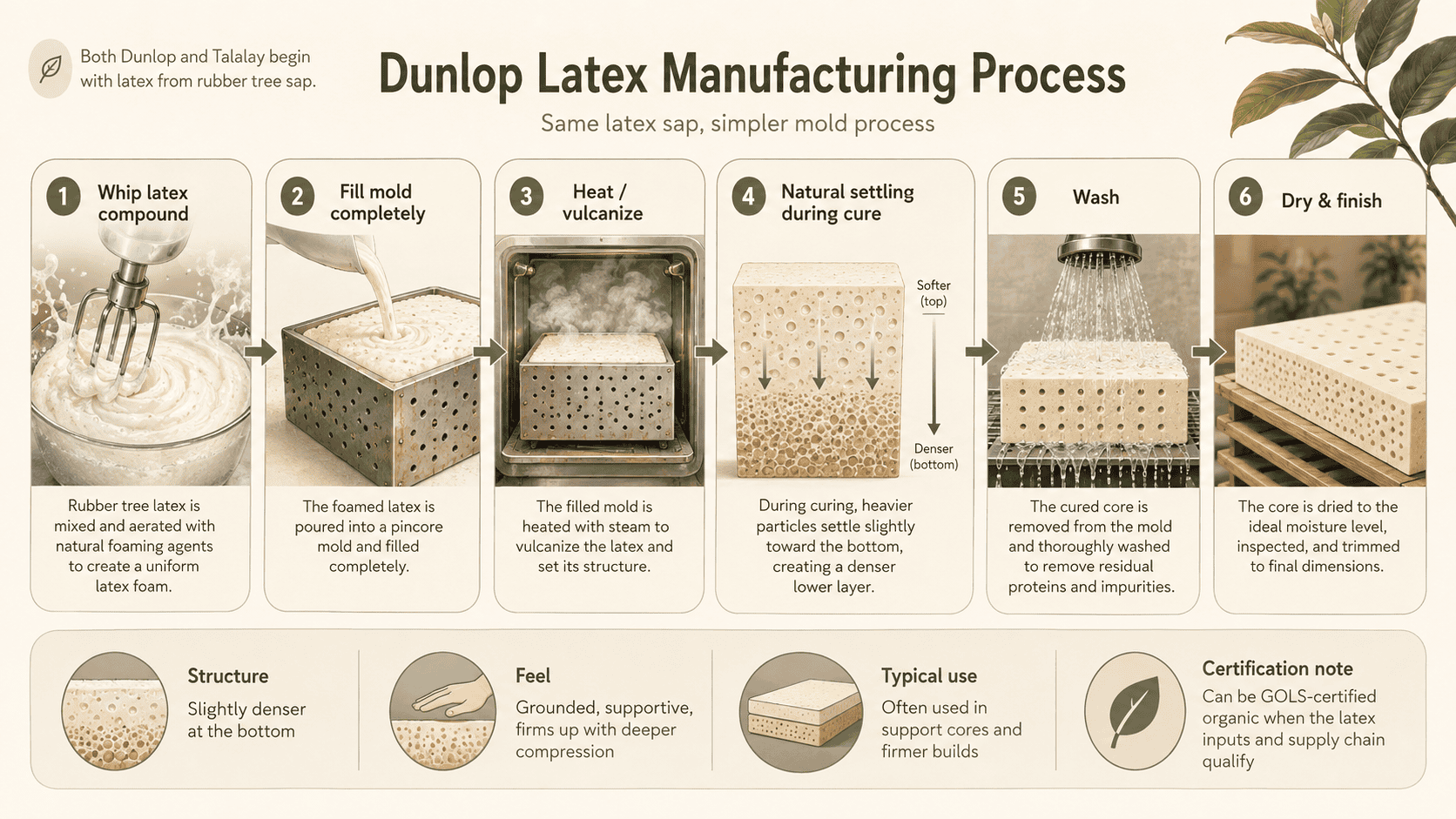
Dunlop is the original method, and it’s beautifully simple: whip the sap into a foam, pour the mold full in one go, bake it. But gravity gets a vote during that bake. Heavier particles settle, so every Dunlop layer comes out a little denser at its bottom face than its top.
Lie on Dunlop, and you get that earthy, grounded, solid, planted feel. A bed that firms up under you as you settle in. In our experience, a Dunlop layer usually feels a touch firmer than its number once you’ve been on it a few minutes.
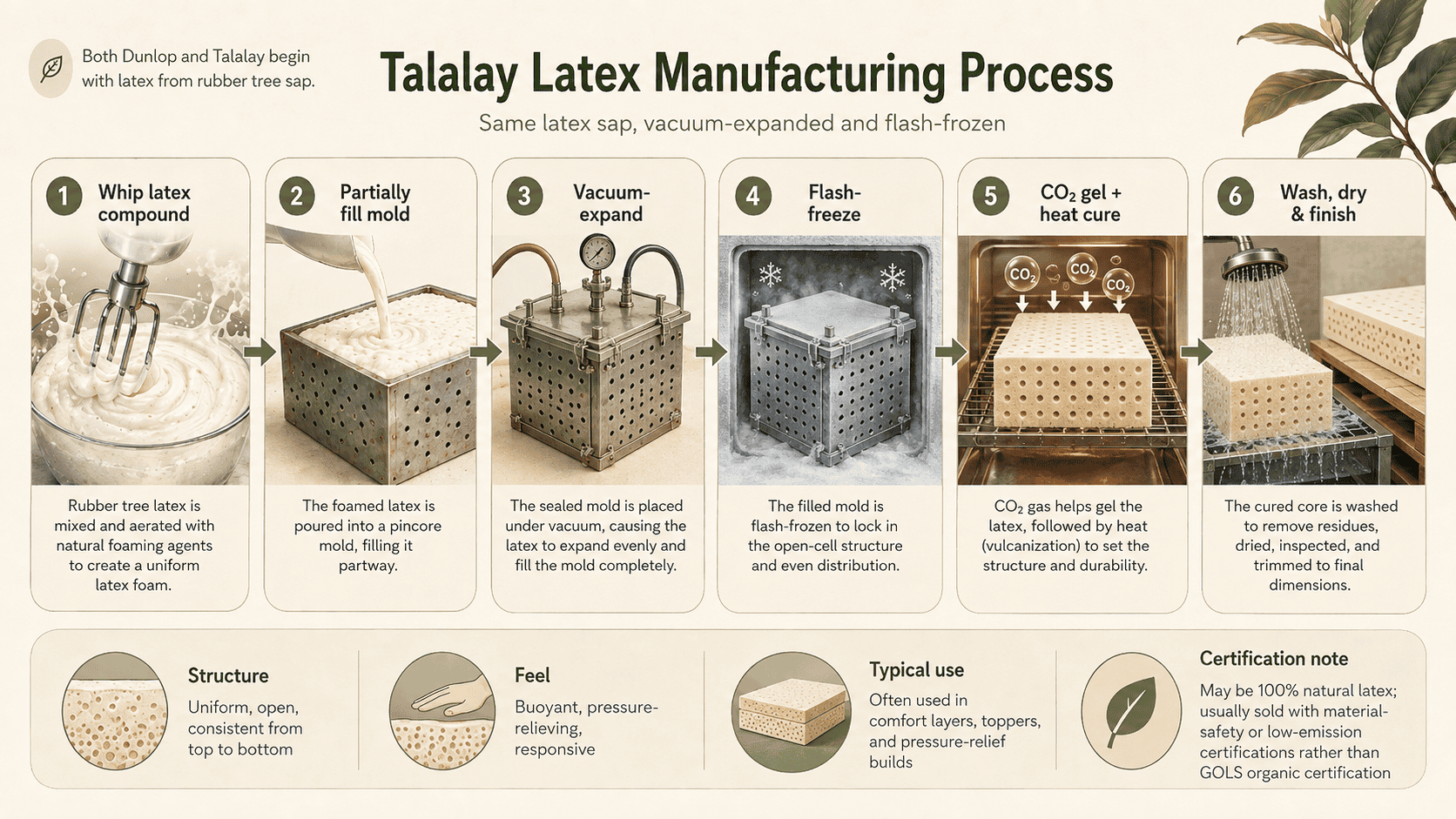
Talalay adds two steps that change everything. The mold is only partially filled, then vacuum-sealed so the foam expands evenly to fill the space. Then, and this is the clever part, the whole thing is flash-frozen before baking, with CO2 pushed through to lock the structure in place.
Freezing first means gravity never gets a say. The cells cure round and uniform, top to bottom. The result is springier and more buoyant: an “on the bed” feel where Dunlop is “in the bed.”
Everything people argue about follows from those two processes:
- Same number, different personalities. A Talalay 32 and a Dunlop 32 are cousins, not twins. Talalay reads softer at first touch and livelier; Dunlop reads more muted and gets firmer the deeper you sink.
- Each has a home turf in the stack. Talalay’s uniformity makes it a superb comfort layer, especially for side sleepers with sharp shoulder pressure. Dunlop’s density makes it the workhorse support core, the layer that resists body impressions for decades. The classic “Talalay up top, Dunlop underneath” pattern exists because it plays each process and characteristic to its strength.
- The extremes belong to different processes. A genuinely plush option, ILDs down in the mid to high teens, is almost certainly Talalay; Dunlop pours become more inconsistent at that softness. The very firm end, low-to-mid 40s, is nearly always Dunlop, where it’s both cheaper to make and more durable.
- Durability is a tie for practical purposes. Dense Dunlop has a slight edge under sustained structural load, one more reason it lives in support cores. Good Talalay keeps its bounce impressively where it belongs, up top. Both outlast every polyurethane foam we’ve ever seen come back on a trade-in.
- Talalay costs more, and the reason is boring: the vacuum-and-freeze process eats more energy and machine time per layer. Paying Talalay prices for a bottom layer you’ll never feel directly is, in our opinion, money misspent. Paying it for the comfort layer your shoulder lives on eight hours a night is often the best money in the build.
One more thing, and we’re careful about this because the industry often isn’t: organic certification for latex (GOLS) exists only for Dunlop. The Talalay process isn’t compatible with the standard. Talalay can absolutely be 100% natural latex, verified by material-safety certifications like OEKO-TEX or eco-INSTITUT, and that’s exactly what good Talalay is. But “organic Talalay” is not something anyone can truthfully sell you. When a listing implies otherwise, that tells you something about the listing.
Oh, and about those suspiciously precise numbers: latex is an agricultural product. Batches vary. That’s why honest manufacturers rate layers in ranges, 30 to 32, not exactly 31. A single number with no range attached is rounding dressed up as precision.
The question nobody asks: which layer?
Here’s the mistake we see most often, including from very well-researched shoppers: asking “what ILD should I get?” without asking “in which layer?”
Take a medium-ish ILD 24 layer:
- As a top layer, it’s doing pressure relief: deciding how far your shoulder sinks before firmer material catches you.
- As a middle layer, it’s a transition: deciding whether the handoff from soft to firm feels seamless or like a soft blanket thrown over a table.
- As a bottom layer, it’s doing alignment. Or in this case probably failing at it, because 24 is soft for structural work under most adults.
The way we explain it in the showroom: the top layer decides how the bed greets you, the bottom layer decides how it holds you at 3 a.m., and the middle layer decides whether the handoff between those two is graceful.
That’s also why “what’s the best ILD” is unanswerable. A 130-pound side sleeper can be perfectly served by 19-to-22 Talalay over a 30-to-32 core. Put a 230-pound back sleeper on that identical build, and he punches straight through the top layer and spends the night riding the transition, feeling a firmer, lumpier bed than the label promised.
Same spec sheet. Opposite outcomes. Both true.
What we actually tell people
After a couple decades of these conversations, here’s the short version, with the caveat that these are starting points and not laws:
Start from body weight. “Medium” means nothing across brands; pounds mean the same thing everywhere. Under about 150 pounds, you probably won’t engage firm latex enough to benefit from it, and you likely need a softer top layer than you think. Over about 220, soft layers compress fully under you; look at firmer comfort layers, firmer cores, and taller builds, 9 to 13 inches.
Then adjust for position. Side sleepers usually go one step softer up top than a back sleeper of the same weight; the shoulder needs somewhere to go. Stomach sleepers go one step firmer, because a hammocking hip is the fastest route to a sore lower back we know of.
Watch the step size between adjacent layers. Neighbors more than about 10 or 12 ILD points apart create that abrupt soft-then-bottom-out feeling. If you want a plush surface and firm deep support, the answer is a medium transition layer in between, not a softer top.
Put your money where your body is. The material premium (Talalay) earns its keep in comfort layers, and the workhorse (Dunlop) earns its keep everywhere else.
When to put the spreadsheet down
We’ll be the first to say it: firmness is a fit problem, not a spec problem. The numbers, understood properly, get you to the right neighborhood. Your shoulder and your lower back cast the deciding vote, and they don’t read spec sheets.
Which is why the most useful question you can ask any latex mattress maker, us included, isn’t “what’s your ILD?”
It’s “what happens if the firmness we pick turns out to be wrong for me?”
Layered construction exists precisely because first guesses are sometimes wrong. A bed whose layers can be rearranged or exchanged turns a wrong guess into an afternoon’s adjustment instead of a return. And a maker who publishes real numbers, in honest ranges, with a straight answer to that question, is showing you how they’ll treat you for the twenty years the mattress is supposed to last.
Brandon Maxey, Sleeping Organic
Written for The Mattress Underground Expert Forum. Original content; not published elsewhere.
All images and graphics in this article were created by The Mattress Underground.
Sleeping Organic has specialized in custom layered natural latex mattresses and personalized sleep systems since 2007.