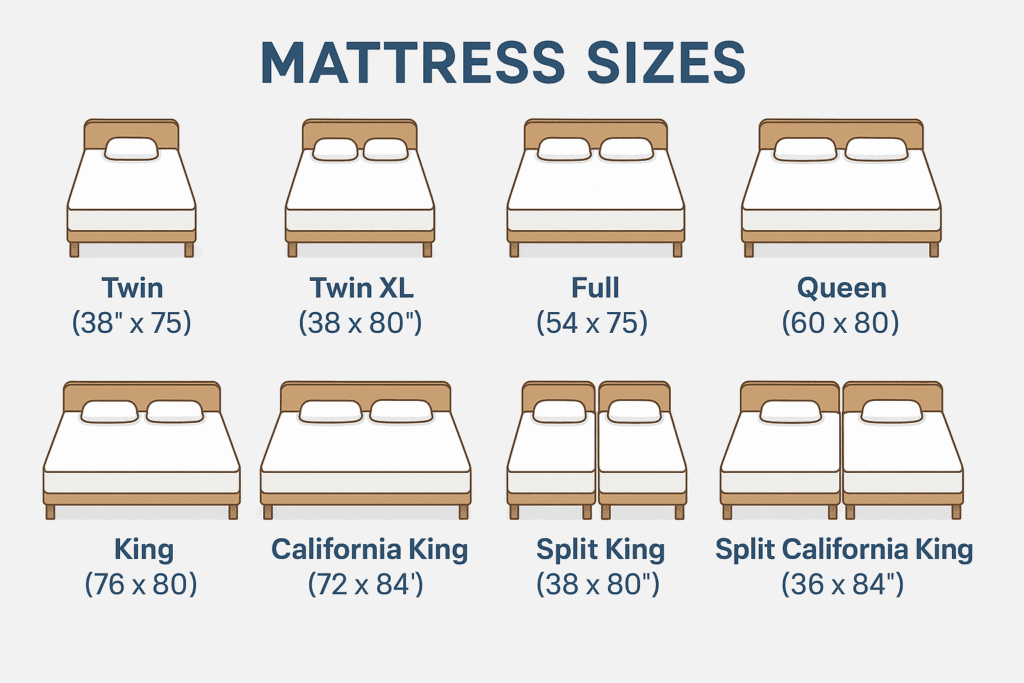
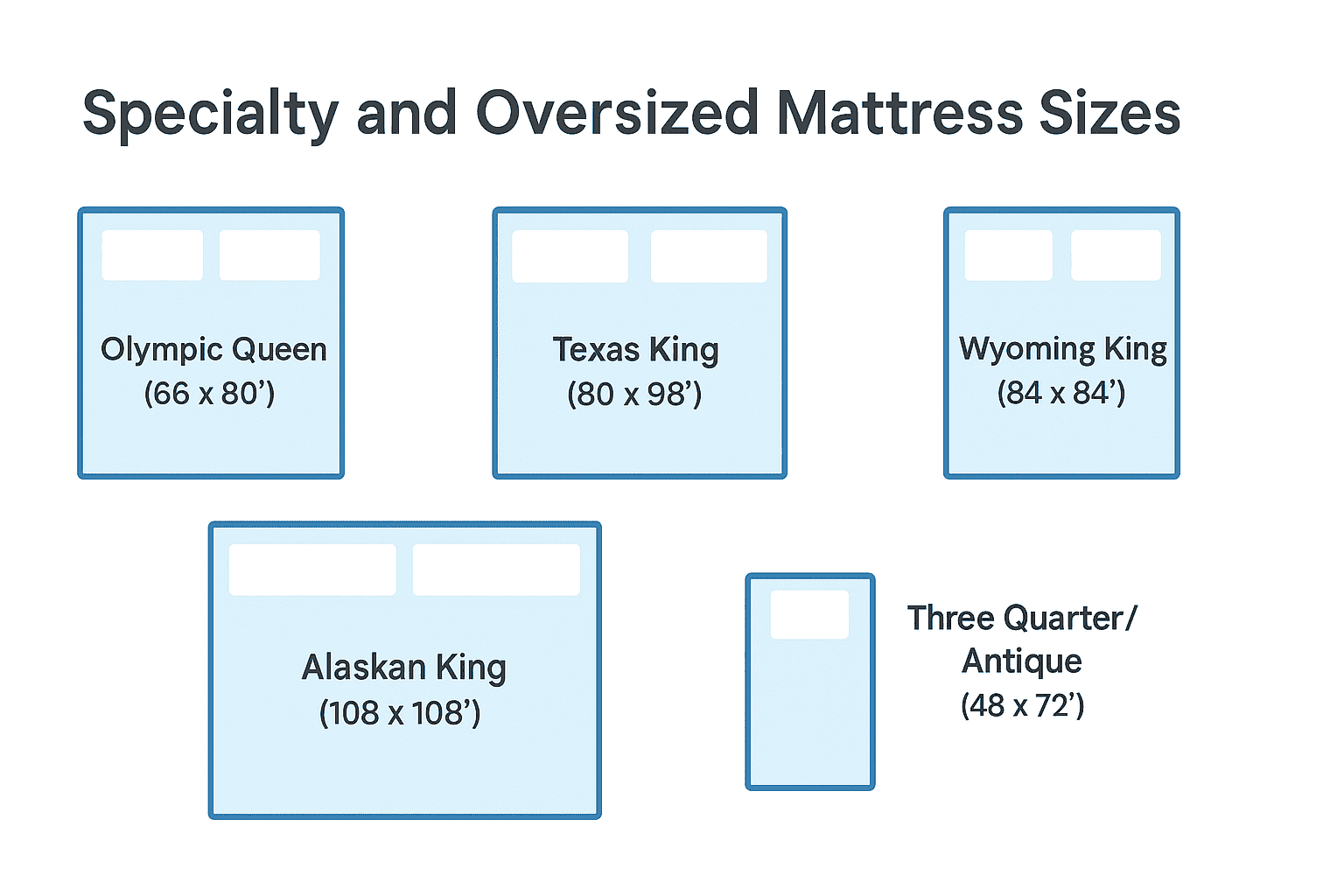
Standard mattress sizes, specialty, and oversized options available in the United States
Introduction
Finding the right mattress starts with knowing which size will best fit your body, your space, and your lifestyle. While comfort and support are the real keys to a good night’s sleep, the size of your mattress can make all the difference in whether you feel relaxed and comfortable …or … cramped and restless.
In the U.S., mattresses are measured in inches (width × length). Thickness, or height, can vary widely depending on the construction and number of layers, so it’s always good to check before buying—especially if you’re pairing your new mattress with an existing foundation or bed frame.
Pro tip: If you’re replacing an older mattress, measure both your frame and your room to be sure the new size works for your space.
Standard U.S. Mattress Sizes
The most common mattress sizes found in most showrooms and online retailers:
Twin (38″ × 75″)
Best for kids, bunk beds, or small guest rooms.
Twin XL (38″ × 80″)
Adds 5″ of length—great for taller teens, adults, or college dorms. Two Twin XLs placed side by side equal a King.
Full/Double (54″ × 75″)
Works for solo sleepers who want more room than a Twin, or for smaller bedrooms where a Queen might feel crowded.
Full XL (54″ × 80″)
Same width as a Full but with extra length for taller sleepers.
Queen (60″ × 80″)
The most popular size for couples. It balances personal space with room-friendly dimensions.
Split Queen (2 × 30″ × 80″)
Two separate mattresses that make up a Queen, often paired with adjustable bases.
King (76″ × 80″)
A spacious option for couples, pets, or kids who sneak into bed.
Split King (2 × 38″ × 80″)
Two Twin XL mattresses placed side by side—perfect for couples who want different firmness levels or an adjustable base.
California King (72″ × 84″)
Narrower than a standard King but longer, making it a favorite for tall sleepers.
Split California King (2 × 36″ × 84″)
Same length as a Cal King but divided into two halves for easier moving and more flexibility.
Oversized & Specialty Mattress Sizes
For those who want even more room—or have very specific space needs—oversized and custom sizes are available. These are usually special-order items.
Olympic Queen (66″ × 80″)
Adds 6″ of width to a standard Queen.
Texas King (80″ × 98″)
Extra-long and wide—great for large rooms.
Wyoming King (84″ × 84″)
A perfect square, offering both width and length for couples or families.
Alaskan King (108″ × 108″)
The largest standard oversized mattress available. Think of it as a “family bed” sized.
Three Quarter/Antique (48″ × 72″)
Common in older bed frames; still available today through specialty manufacturers.
Measuring Tips
Room size matters. Leave at least 2–3 feet of walking space around the sides and foot of the bed.
Don’t forget height. Mattress thickness can range from 6″ to 18″ or more. Make sure it works with your bed frame and bedding.
Consider who’s sleeping. Solo sleepers may find a Full or Queen more than enough, while couples often appreciate the extra space of a King or California King.
FAQs About Mattress Sizes
What’s the difference between a Twin and a Single?
→ They’re the same size: 38″ × 75″.
Do two Twins equal a King?
→ No! Two standard Twins together are shorter. Two Twin XLs equal a King.
Why choose a California King over a regular King?
→ A Cal King is longer but slightly narrower, making it ideal for taller people.
What’s the most popular mattress size?
→ The Queen—because it fits in most bedrooms and works well for couples.
Final Thoughts
Mattress sizes aren’t one-size-fits-all. The right choice depends on your body, your sleep style, your bedroom space, and whether you share your bed. Once you know the dimensions that fit your lifestyle, you can focus on the fun part: finding the mattress that gives you the perfect balance of comfort and support.